


 Escrito por Nate KostarRedatorRevisado por Robert LakinEditor
Token de ouro da Tether recebe certificação islâmica para ampliar adoção
Últimas NotíciasPublicado27 de jul. de 2026
A certificação permite que o XAUt amplie seu alcance entre instituições financeiras islâmicas e investidores que buscam exposição ao ouro físico em conformidade com a Shariah.

Tether’s gold-backed token XAUt has received Shariah certification from Amanah Advisors, a move that could expand access to the token among Islamic financial institutions and investors seeking Shariah-compliant exposure to physical gold.
The certification found XAUt’s structure complies with key Islamic finance principles, including full backing by physical gold, the absence of interest and leverage, and transparent reserves. Each XAUt token represents one troy ounce of physical gold stored in Swiss vaults, according to Tether.
The designation gives Tether a clearer pathway to market XAUt to Islamic financial institutions and investors that require Shariah-compliant investment products. Tether said it expects the certification to support adoption across markets where Islamic finance is widely used, including the Gulf Cooperation Council, South Asia and parts of Africa.
XAUt is one of the largest tokenized gold products in the crypto market. Tether’s latest reserves report showed the token was backed by more than 707,000 troy ounces of physical gold worth over $3.3 billion as of March 31.
According to RWA.xyz data, the token’s onchain asset value has climbed from about $700 million in July 2025 to roughly $2.5 billion.
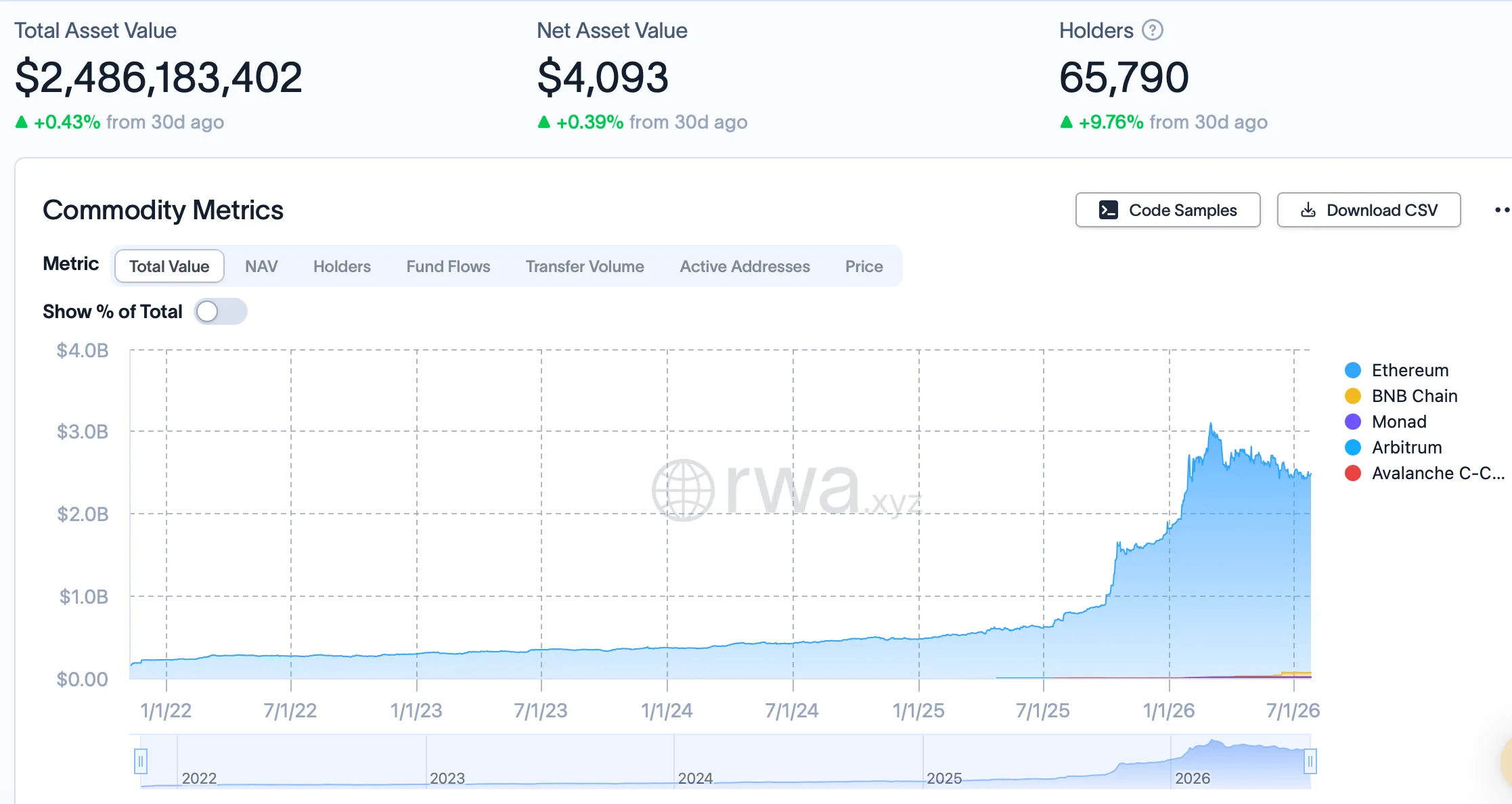
Tether tokenized gold. Source: RWA.xyz
Shariah-compliant crypto products gain traction
Cryptocurrencies have long divided Islamic scholars, with debates centering on whether digital assets comply with Shariah principles that prohibit excessive uncertainty, speculation and interest. As companies seek to address those concerns, Shariah-compliant digital assets have begun to emerge.
One early example came in 2025, when Bahrain-based AlAbraaj Restaurants Group adopted a Bitcoin (BTC) treasury strategy and said it planned to develop Shariah-compliant financial instruments to broaden access to Bitcoin across the Islamic world.
More recently, in April, Palm Azgar Finance expanded its Shariah-compliant PUSD stablecoin to ADI Chain, targeting the more than $3 trillion Islamic finance market. PUSD became the second stablecoin available on the network, allowing institutions to settle transactions using either a dollar-linked asset or a dirham-denominated token on the same infrastructure.
Meanwhile, Dubai has emerged as a leading crypto hub in the Middle East, continuing to expand its regulated digital asset market. Earlier this month, the emirate’s Virtual Assets Regulatory Authority (VARA) issued its 50th virtual asset service provider license, surpassing the number of licensed crypto firms in Hong Kong and Singapore.
A Cointelegraph está comprometida com um jornalismo independente e transparente. Este artigo de notícias é produzido de acordo com a Política Editorial da Cointelegraph e tem como objetivo fornecer informações precisas e oportunas. Os leitores são incentivados a verificar as informações de forma independente. Leia a nossa Política Editorial https://cointelegraph.com.br/editorial-policy
Mais sobre o assunto